JEE Main from 2002. JEE Advanced from 2007. NEET-UG from 2000. Not summaries of them. The actual questions, indexed one at a time.
Papers read
20+ years
JEE Main 2002 to 2025, Advanced 2007 to 2025, NEET-UG 2000 to 2026.
Questions indexed
50,000+
Real previous-year questions, searchable by year, subject and topic.
Subjects covered
4
Physics, Chemistry, Mathematics and Biology.
Models trained
2
One per exam. Neither is a general-purpose model pointed at a syllabus.
Optics39
Laws of Motion33
Current Electricity33
Kinematics32
Electrostatics30
Rotational Motion28
Atoms and Nuclei28
Units and Measurements23
p-Block Elements43
Organic Compounds Containing Oxygen35
Solutions31
d- and f-Block Elements27
Chemical Thermodynamics27
Organic Compounds Containing Halogens25
Biomolecules24
Redox Reactions and Electrochemistry24
Coordinate Geometry61
Three Dimensional Geometry52
Limit, Continuity and Differentiability32
Statistics and Probability30
Integral Calculus28
Trigonometry25
Differential Equations23
Sets, Relations and Functions22
The exam repeats itself. Most students never see it.
Across two decades the same chapters keep returning, in shares that barely move. The engine counts them. What you are looking at is its own weighting for JEE Main 2026, chapter by chapter.
Each number is the engine's forecast question count for that chapter in JEE Main 2026. The bar is that chapter's share of the subject.
Then it works the way a good teacher works.
A question goes in. What comes back is not an answer with a number attached. It is the reasoning that produced it, one line at a time.
1
Read the question
Variables, constraints and the actual ask, separated first.
2
Place it
Matched against two decades of papers for its relatives.
3
Pull the concept
The governing law, retrieved rather than guessed at.
4
Work it
Every line follows the one above it, and is named.
5
Check it
Verified by IITian faculty before a student sees it.
A charged ring sits in a magnetic field that is switched on. Find its angular acceleration.
Given
A ring of mass m, radius R, carrying charge q, at rest.
Concept
A changing magnetic field induces a circular electric field along the ring.
Step 1
That induced field puts a tangential force on the charge, so the ring feels a torque.
Step 2
Set that torque equal to Iα, with moment of inertia I = mR².
Step 3
The radius cancels, which is why the answer does not depend on how big the ring is.
Answerα = qB / 2m
Then it calls the paper, before the paper exists.
For JEE Main 2026 the forecast was published in advance. This is how much of the real paper it had already covered.
92%
92 per cent of JEE Main 2026 topics, predicted in advance
Physics
97%
Chemistry
94%
Mathematics
83%
Concept-level matches
251
JEEnius predicts topic areas and question patterns, not the exact paper, and is not affiliated with NTA, NMC or any exam body.
All of it, in your hand.
An engine is only useful if it fits inside a study day. So it ships as an app you can open between classes.
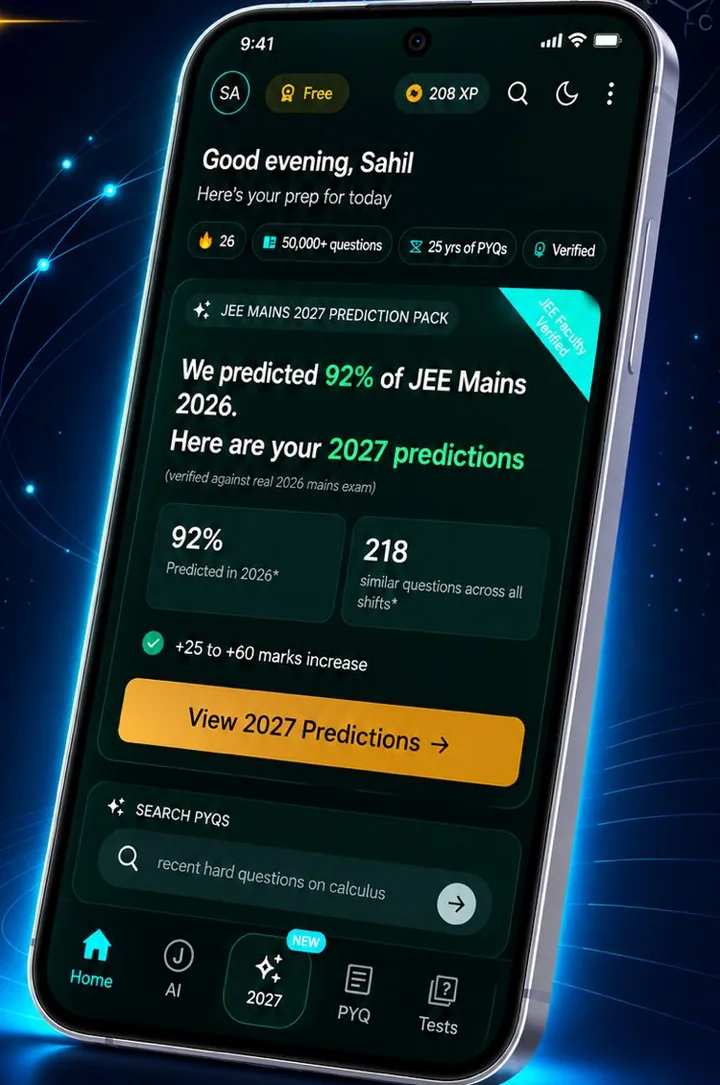
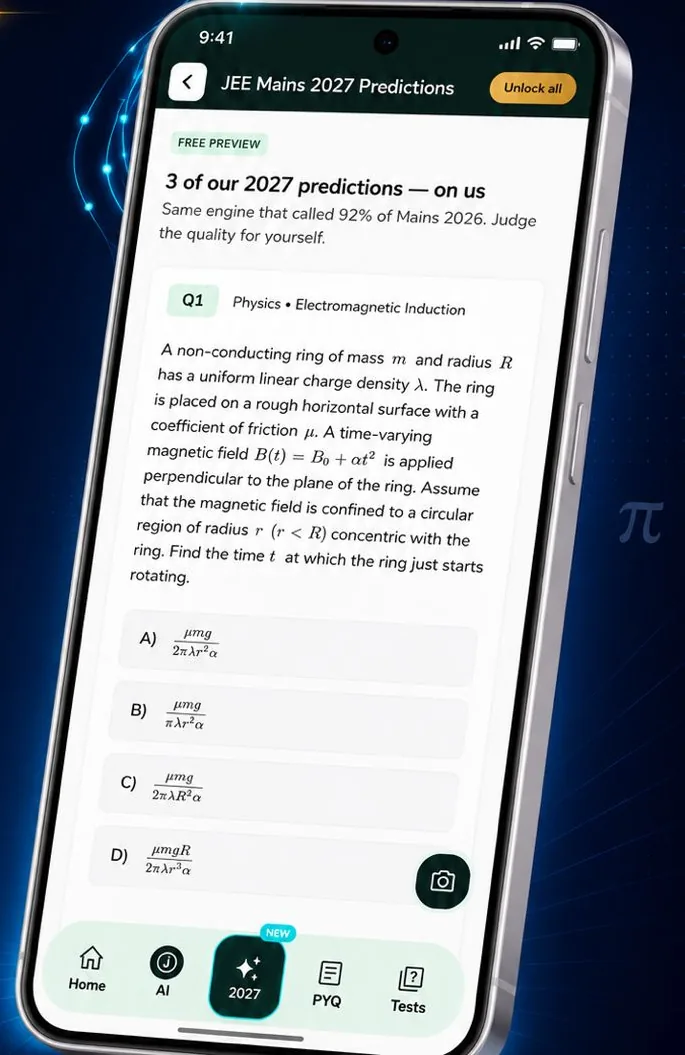
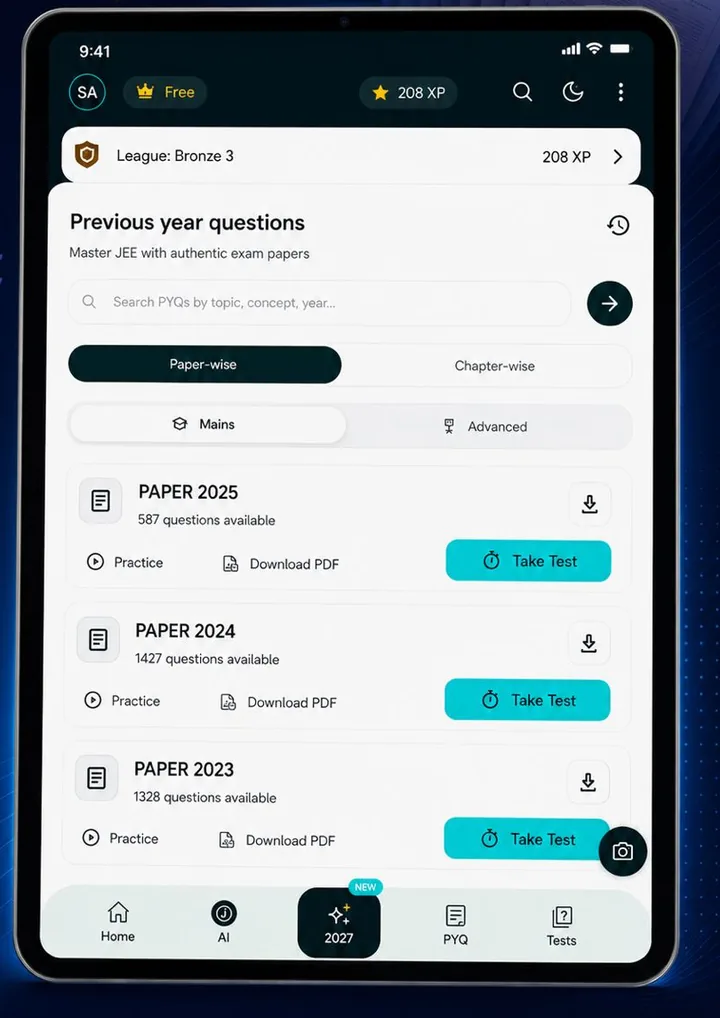
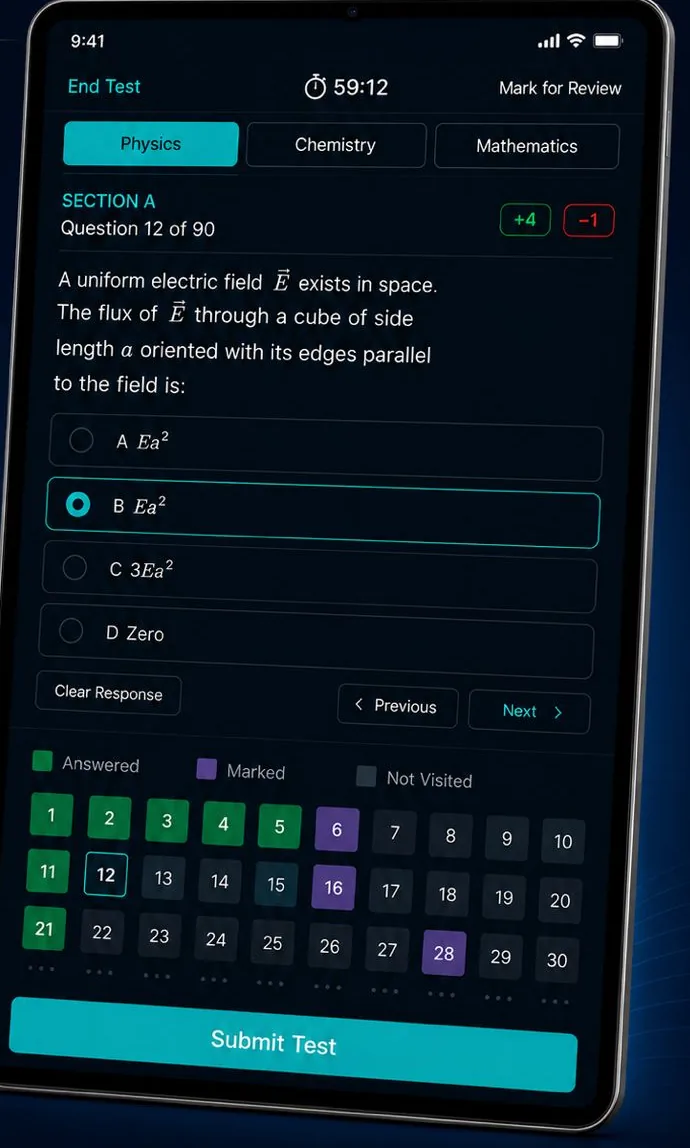
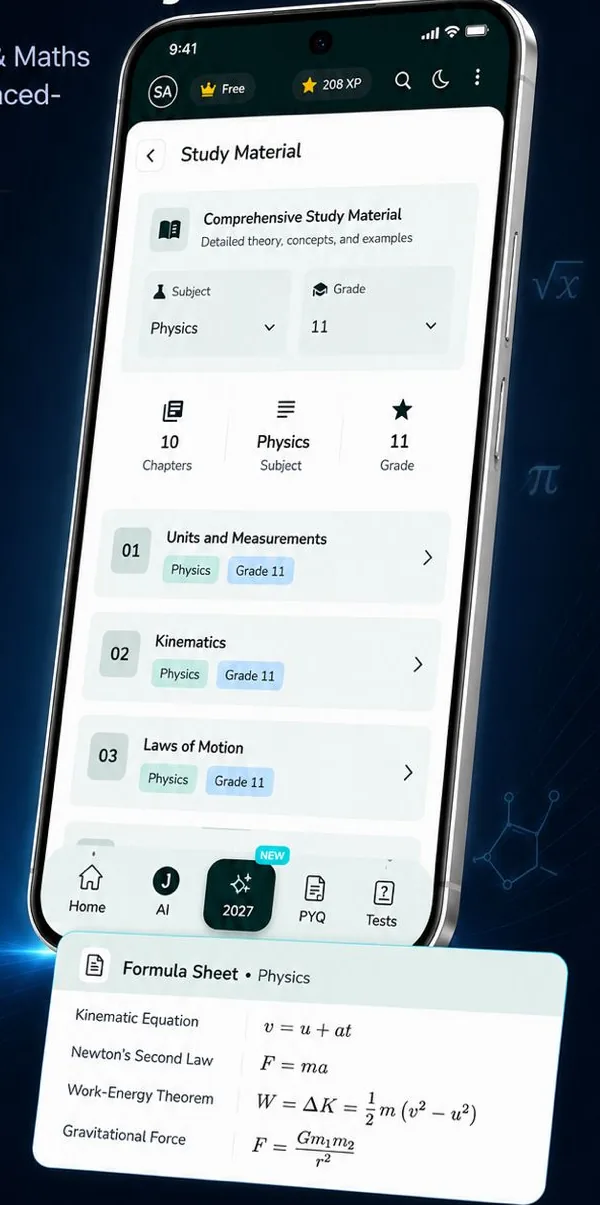
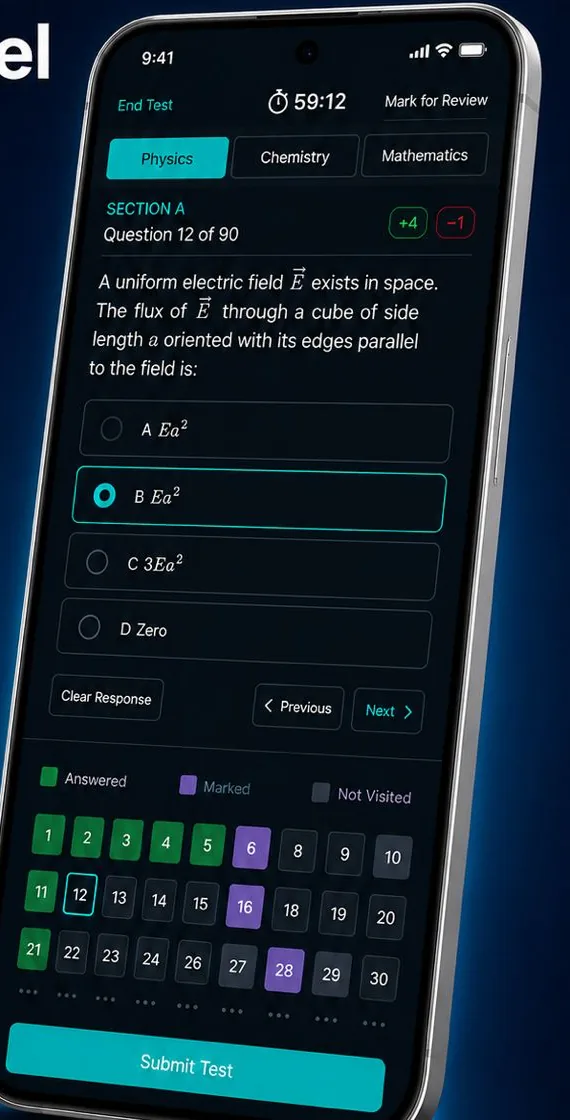
Your day, firstStreak, XP and the current prediction pack, before anything else.The predicted paper2027 predictions in the format of the real thing. Three are free to try.Every paper, paper-wiseBrowse by year or by chapter, then sit any of them as a timed test.A mock that feels like the hallNTA-style layout, +4 and -1 marking, the same palette and review flags.Theory and formulasChapter-wise material, with the formula sheet one tap away.On the phone tooThe same test interface, sized for the device you actually study on.
Free to start. No card needed.
Open it in the browser, or install the Android app.
JEEnius is a Grey Neural AI product. Its solving engine includes Fathom AI, which answered every question in the JEE Advanced 2025 mathematics paper correctly, and every solution is verified by IITian faculty.
32 / 32
Fathom AI answered every question in the JEE Advanced 2025 mathematics paper. It is part of the solving engine.
20,000+
students preparing on JEEnius across the JEE and NEET apps.
4.4 ★
on Google Play, from more than 100 ratings.
Questions, answered
JEE JEEnius is for engineering aspirants (JEE Main & Advanced); NEET JEEnius is for medical aspirants (NEET-UG). Each runs on AI models custom-trained for its exam, with the same proven approach: real PYQs, step-by-step solutions and predicted mocks.
The engine indexes every previous-year question by chapter and concept, measures how each topic's weighting has moved across two decades, and forecasts the share of the next paper each chapter is likely to take. For JEE Main 2026 that forecast covered 92% of the topics that appeared (Physics 97%, Chemistry 94%, Maths 83%), with 251 concept-level matches, 12 of them near-identical. It predicts topic areas and question patterns, not the exact paper.
Two focused apps, one for JEE and one for NEET, so each experience is tailored to that exam. Pick the one that matches your goal.
JEEnius is built by IITians and is a product of Grey Neural AI, which builds human-centric AI tools. Our engine includes reasoning models fine-tuned for high-level exam problems.
Both products are free to start. JEE JEEnius paid plans are ₹99 and ₹299 a month, and NEET JEEnius paid plans are ₹299 and ₹599 a month, with lower prices on annual billing. The 2027 Prediction Packs are one-time purchases: ₹1,499 for JEE Main and ₹1,999 for NEET. Prices as of October 2026. Current prices: JEE pricing · NEET pricing.
Yes. JEE Main and NEET-UG are both held in 13 languages, and both apps offer all 13: English, Hindi, Bengali, Marathi, Gujarati, Tamil, Telugu, Kannada, Malayalam, Odia, Punjabi, Assamese and Urdu. Screens, chapter names and AI doubt answers follow the language you choose, with Urdu shown right to left. Practice questions and their solutions stay in English, and the 12 Indian languages are in Beta.